Three churches, all lnk, all big, blousie and pretty poor examples of their kind. St Andrew is the best of a poor bunch and Pevsner is unusually generous.
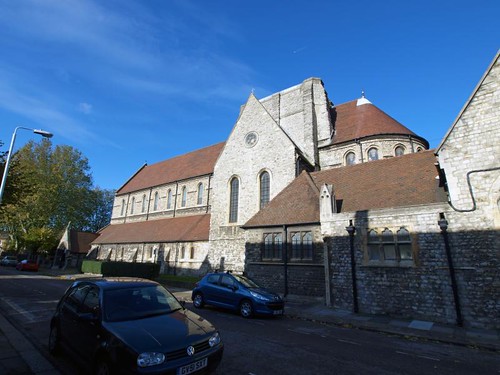
ST ANDREW, The Drive. 1924 by Sir Herbert Baker. In comparison with Lutyens Baker may be one of the smaller fry. In a between-the-wars-suburban area a church such as St Andrew will at once be noticed as remarkable. Tall, red brick, with tall, slim W bell-turret and a copper-roofed baptistery apse between two round-arched entrances below. The interior has a low round-arched arcade with no capitals at the springing of the arches, a tall clerestory and a tall apse with two-light windows. That is: a frank mixture of Gothic and classical motifs.
ST LUKE, Uphall Road. 1941 by E. T. Dunn. Mr Goodhart-Rendel calls the church uncommonly fine, though entirely traditional.
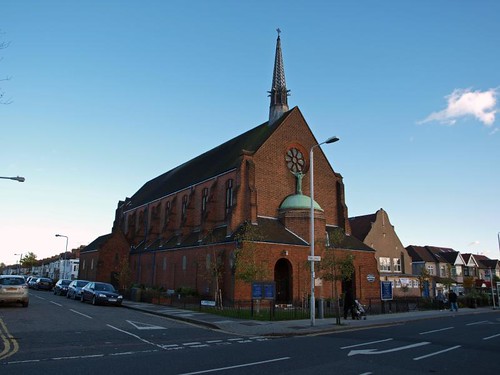 |
| St Andrew |
|
|
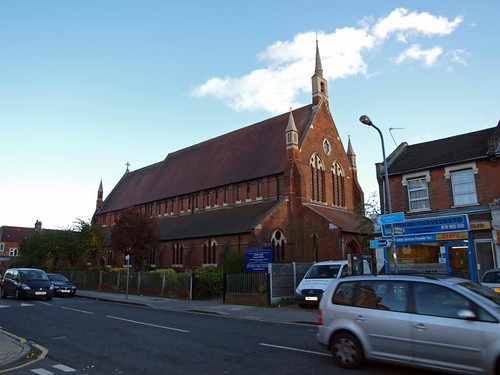 |
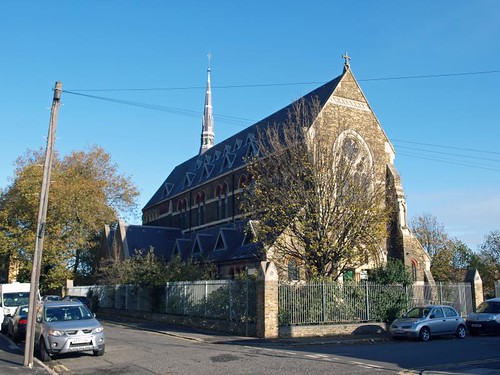
| St Alban the Martyr |
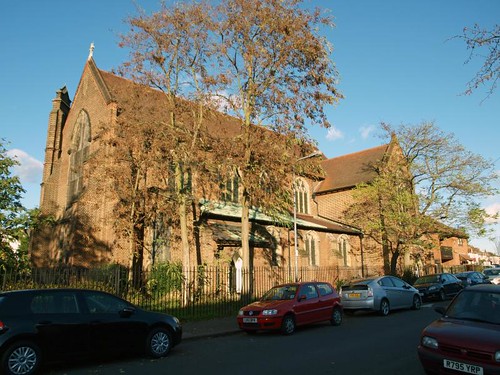 |
| St Luke |
ILFORD. It has come into London, of course, and its 138 square miles is packed with 200,000 people; but only 100 years ago the River Roding was running through green pastures here and Ilford folk were going to service in the little medieval chapel of the Hospital of St Mary. It keeps its old chapel still, and it vies with the great new church in its appeal to pilgrims.
Among many other churches which have grown up are St Mary’s with an apse and a spire, and St Clement’s with its imitation Gothic; but the great monument of our time at Ilford is Sir Herbert Baker’s brick church of St Andrew’s.
Ilford is now the controlling centre of half-a-dozen places (Chadwell Heath, Seven Kings, Newbury Park, Barkingside, Goodmayes, Aldborough Hatch, and part of Becontree, the LCC’s great estate) and it has a town hall which ranks among the best civic buildings of outer London. It has also 1000 acres set aside for a great airport. Among its old places is what is left of the Hospital of St Mary, the little chapel kept in repair by the Marquis of Salisbury, who maintains the chaplain and provides for the six poor people who took the place of the lepers centuries ago. It is 15th century, and the oldest building in the town.
We come from the Roman highroad by a charming gateway to find their one-storeyed homes facing each other across a courtyard, with the chapel looking on. Their homes were new two centuries ago, and the chapel was made new in the 17th and 19th centuries, but the chancel remains wholly medieval, a tiny place 16 feet wide with glass in the windows three or four centuries old, showing the Madonna and St Elizabeth as gems of colour in the tracery. An old stone priest who is thought to be John Smythe, master of the Hospital 500 years ago, lies in his robes under a new canopy. The panelled back of his old tomb being now in a wall. There is a big modern painting of Christ on the Road to Calvary.
Sir Herbert Baker’s great church is set on Ilford’s highest point, with spacious streets about it. It is somewhat like Sir Herbert’s cathedral at Pretoria, and is 145 feet long and 80 feet high, with a small graceful spire of oak and lead. The copper-domed roof of the baptistry, rising between two entrance arches at the west end, is crowned with a bronze figure of Peace by Charles Wheeler, and the apse at the east end has Gabriel sounding his trumpet, designed in tiles by Henry Holiday.
The interior with its seven bays is like a basilica, with barrel roofs over narrow aisles lighted by round-headed windows, their arches all different. The baptistry recess has a roof in brick and tile suggesting great beams of light radiating from a panel of the Dove, by Phoebe Stabler, the architect’s gift to the church.
In the roof of the nave are six beams each weighing a ton. The roofs of the chancel and the soaring apse are of barrelled and vaulted brickwork, and the apse windows have exceptional grace. But the gem of the stained glass is a window in the north aisle showing the Madonna crowned. In this green and blue jewel Carl Parsons surpasses all his other windows here, but those on either side of the Madonna, one of Christ the Carpenter, the other of Solomon the Builder, are delightfully apt, for this chapel is the gift of the church’s own builder, Alfred Griggs, whose proud opportunity it was, as Mayor of Ilford, to hold his civic inauguration in this church of his own building. The chapel is a memorial to his parents and his brother Horace, an Ilford lad who meant to be a priest but gave his young life as a soldier. In one window we see him as a student at Oxford, in another as an officer in France, and the altar, lectern, and litany desk were all made with his hands for the church hall when he was quite a boy.
The wave of enthusiasm which set this fine church on the hill broke into a hundred gifts for it, and they are everywhere, so that the church has become a storehouse of memories. Remembered above all is Dr Edgar Jacob, the bishop who left his diocese of Newcastle to organise the church in this fast growing suburb of Greater London. The church is his monument, as it is also the monument of a group of fine modern craftsmen. Its beautiful woodwork was designed by Laurence Turner, the noble altar triptych by Colin Gill; the fine altar linen was done by a lady who worked at it for years and died a year or two before the church was consecrated.
We found another band of enthusiasts carrying on the health activities of Ilford in a 17th century house in Valentine’s Park, home of the vine from which Hampton Court’s famous great vine came. The parent stem died some years ago, but its offshoot bears its wondrous harvest of over a thousand pounds of grapes every year. One more modern church here, St Peter’s, we found at Aldborough Hatch near Barkingside, and it is interesting because it has in its walls some stones from old Westminster Bridge, the bridge on which Wordsworth stood when it seemed to him that
Earth has not anything to show more fair.
Flickr.